


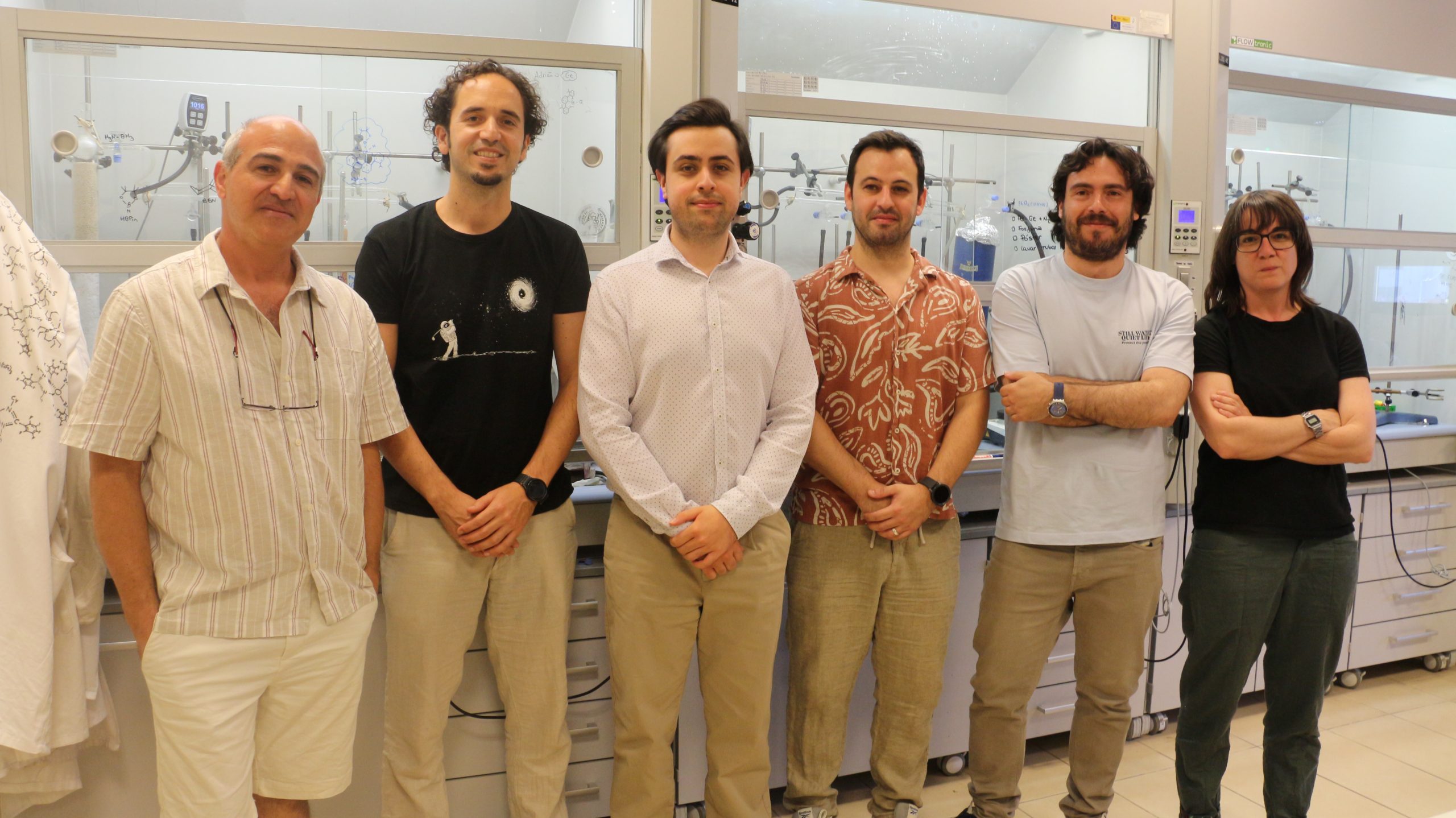
Hernán Míguez García (CSIC), Jesús Campos Manzano (CSIC), Manuel Romero Aguilar (CSIC), Félix León García (US), Gabriel Lozano Barbero (CSIC) y Sonia Bajo Velázquez (US)
A research team from the Institute of Chemical Research (IIQ) and the Institute of Materials Science of Seville (ICMS) —joint centres run by the Spanish National Research Council (CSIC) and the University of Seville— has succeeded in stabilising a molecule excited by visible light for more than 10 hours at room temperature. This discovery represents a significant advance in the field of photochemistry and opens up new possibilities for developing more sustainable and efficient chemical processes.
In the study, published in the journal Nature Chemistry, the research team has succeeded in stabilising a germylene molecule (an organometallic compound consisting of germanium and carbon atoms), maintaining it in a triplet state for over 10 hours. This state arises when the molecule absorbs light and enters a higher-energy state, also known as the ‘excited state’, in which it becomes much more reactive and behaves differently from its usual state, thereby expanding its potential applications and range of transformations.
These states usually last only fractions of a second, which makes them extremely difficult to study. In this study, the researchers have developed a strategy capable of ‘trapping’ this excited state and prolonging its lifetime for hours, something completely unusual in this type of process. This represents a breakthrough in the field of chemistry, as for the first time they have been able to study the behaviour of this molecule in detail.
“We began this work out of pure curiosity, irradiating a molecule we have been working with for years. What we did not expect was to be able to freeze an excited state so energetic that it can even break the benzene ring,” notes CSIC researcher at the IIQ, Jesús Campos, senior author of the study.
“The measurements have confirmed the high stability of the excited germilene, which takes around 14 hours to deactivate,” said Gabriel Lozano, a CSIC researcher at the ICMS, who also highlighted the new avenues this research opens up. “This collaboration between the groups has been particularly inspiring for everyone and has enabled us to discover a new field to explore,” Lozano emphasised.
The results achieved were made possible by the multidisciplinary approach and the combined expertise in organometallic chemistry and photonics of the researchers from both teams.
Indeed, this innovative approach to organometallic chemistry was one of the reasons why researcher Jesús Campos was recently awarded the ‘María Teresa Toral’ National Research Prize for Young Researchers by the Ministry of Science in the field of Chemical Science and Technology.
Reduces benzene
In addition to its extraordinary stability, excited germylene has demonstrated reactivity far superior to that of its conventional form. The study reveals that it is capable of activating and breaking extremely strong chemical bonds, including the cleavage and double reduction of benzene, a molecule considered particularly stable and difficult to transform.
This result is particularly significant because the activation of such strong bonds usually requires very harsh conditions or the use of expensive and scarce transition metals. In contrast, the new system operates under mild conditions, at ambient temperature and pressure, using visible light as an energy source.
The researchers highlight that this discovery opens up new possibilities in chemistry involving main-group elements, such as germanium, where the use of light to access excited states has been very little explored. In the long term, this approach could contribute to the development of more selective and sustainable chemical methods for transforming complex molecules, reducing dependence on precious, expensive and scarce metals, and harnessing clean energy sources such as light.
Reference:
Soto, E., Leon, F., Romero, M. et al. A photoexcited triplet state germylene with a half-life of hours at room temperature. Nature Chemistry. (2026). https://doi.org/10.1038/s41557-026-02153-2