


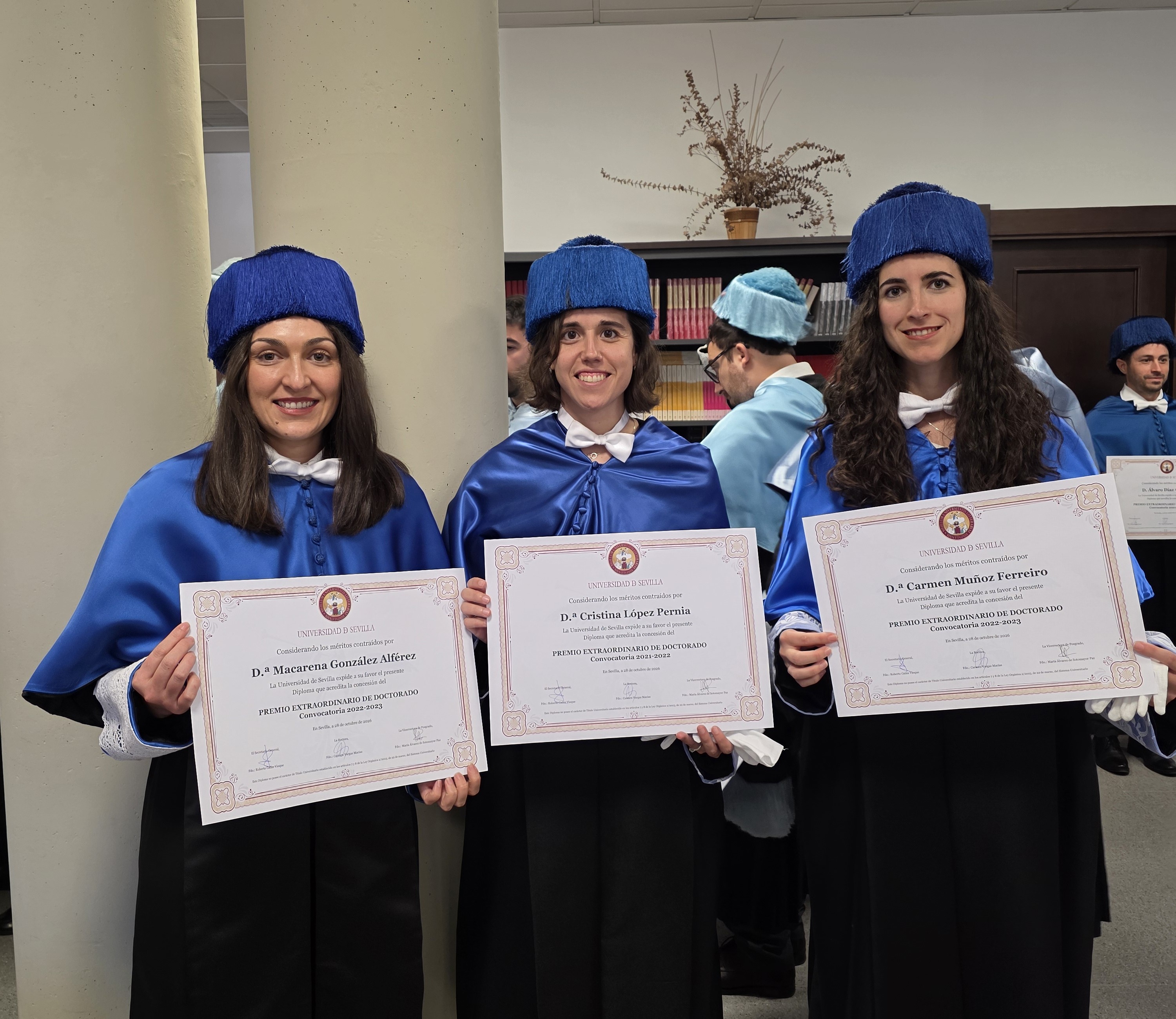
The findings presented in Macarena González’s thesis form part of one of the research areas pursued by the Organometallic Chemistry and Homogeneous Catalysis Group at the Institute of Chemical Research (a joint centre of the CSIC and the University of Seville), one of whose main objectives is the study of bimetallic systems for the activation of small molecules and their use in catalytic applications.
Whilst metal-metal bonds have been a feature of the development of organometallic chemistry since its inception, the design of bimetallic structures has seen only sporadic progress over the decades. However, due to the current keen interest in the development of cooperative systems for bond activation and their use in homogeneous catalysis, the field of bimetallic complexes is enjoying a remarkable renaissance. The reality is that they offer additional tunable properties compared to monometallic compounds, including the ability to modulate the polarity and order of metal–metal bonds and the capacity to effect bond activation via multi-site mechanisms.
In this context, the focus has been primarily on highly polarised heterobimetallic structures in which one of the metals exhibits strong Lewis basicity and the other strong Lewis acidity. This is clearly linked to the field of frustrated Lewis pairs (FLPs) and is also related to many metalloenzymes that are based on similar bimetallic synergies.
The content of this thesis is organised into four chapters. The first contains a general introduction, providing an overview of bimetallic chemistry and paying particular attention to bimetallic designs that behave as FLPs, one of the main original objectives of this thesis. Furthermore, other types of cooperative chemistry aligned with the concept of metal-ligand cooperation (MLC) are briefly discussed. The second chapter focuses on the basic Lewis behaviour of an Rh(I) compound of the formula [(η5-C5Me5)Rh(PMe3)2], which has been reacted with a broad family of transition-metal and main-group electrophiles to design bimetallic structures known as metal-only Lewis pairs (MOLPs). The third chapter exploits the basicity of this Rh(I) compound in an attempt to construct a frustrated transition-metal-only Lewis pair (TMOFLP) based on an Rh(I)/Au(I) pair. These studies highlighted the non-innocent nature of the cyclopentadienyl ligand, a topic investigated in depth in this thesis. Indeed, Chapter 4 focuses on investigating this non-innocence by incorporating boron-bearing side groups into this ligand and the related indenyl fragment. The aim here was to design bifunctional aromatic ligands to bind to the rhodium centre and thereby access cooperative Rh(I)/borane catalysts. Our results on the hydrogenation of olefins, used as a reference, are described in this final chapter.
In order to qualify for the International Doctoral Distinction, this thesis has been written in English; only these general considerations and the final conclusions are included in Spanish. Furthermore, in accordance with the current regulations for applying for the aforementioned distinction, Macarena González spent a period of three months working under the supervision of Prof. Ulrich Hintermair at the University of Bath, UK. She conducted research into the synthesis and reactivity of iridium complexes stabilised by PNP-type clamp ligands.