


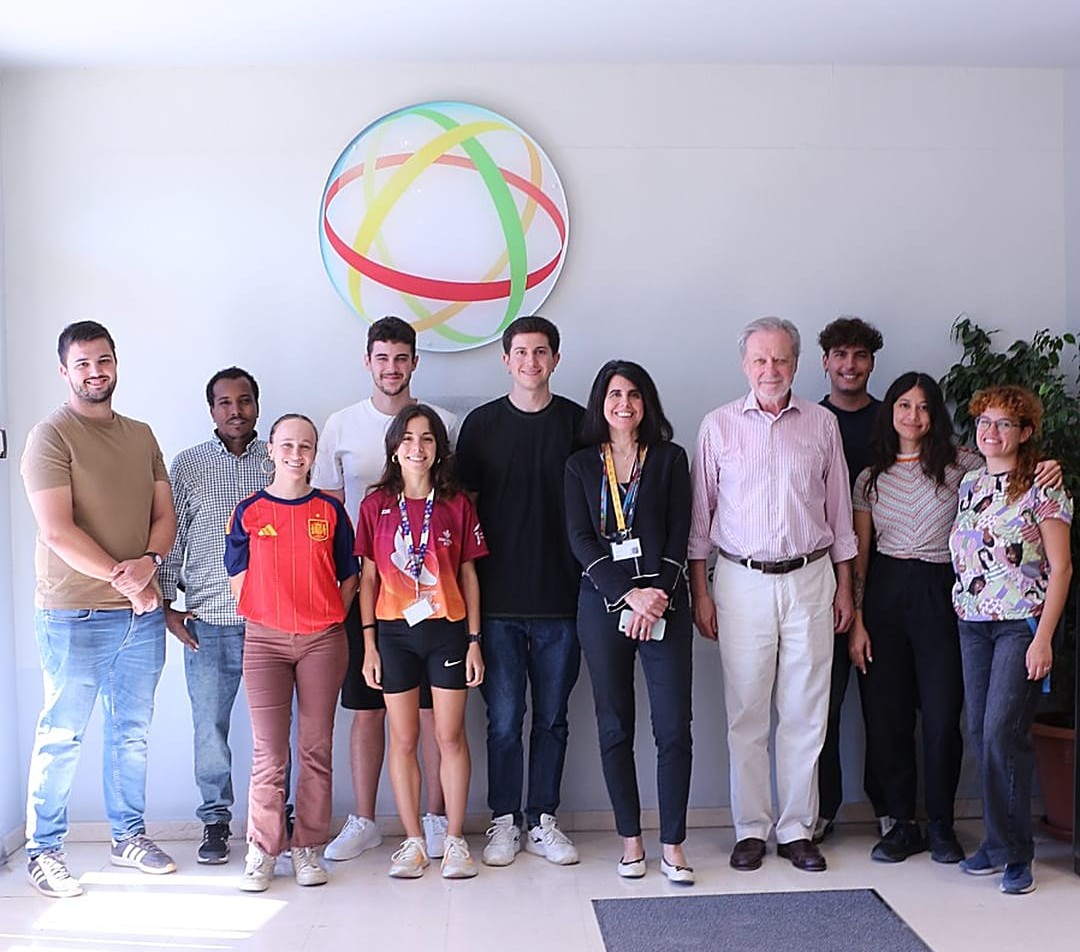
A team from the University of Seville, affiliated with the Institute of Chemical Research, has discovered how small chemical modifications can alter the structure and localisation of the NPM1 protein, which is implicated in around 30 per cent of cases of acute myeloid leukaemia.
Acute myeloid leukaemia (AML) is a particularly aggressive form of blood cancer with a high mortality rate, especially amongst older people. The five-year survival rate is around 30 per cent for patients as a whole and falls below 10 per cent among those over 60. One of the most common genetic changes in this disease affects the nucleophosmin (NPM1) gene, a protein essential for cell function which is mutated in around 30 per cent of AML cases.
Now, a team from the Biointeractomics group, led by Professor Irene Díaz Moreno, has identified a molecular mechanism that helps explain how NPM1 changes its behaviour within the cell. The study shows that certain chemical modifications, known as phosphorylations, can act as a veritable ‘switch’: they alter the protein’s structure and facilitate its movement between different cellular compartments.
The findings, recently published in the international journal *Proceedings of the National Academy of Sciences* (PNAS), show that these modifications affect the electrical charges of NPM1. As a result, the protein loses part of its ordered structure, adopts a more flexible and dynamic state, and changes the way it interacts with other molecules. This may make it easier for it to leave the nucleolus, a region of the cell nucleus where it is normally concentrated.
A protein that changes state in response to cellular damage
Under normal conditions, NPM1 is mainly localised in the nucleolus and plays a role in functions essential to the cell, such as ribosome production and the maintenance of nuclear organisation. However, when the cell undergoes stress or DNA damage, this protein can be redistributed across different cellular compartments and contribute to the response to these disturbances.
“Post-translational modifications such as phosphorylation events rewrite the molecular landscape of proteins. By reshaping the charge, they reshape the dynamics; by reshaping the dynamics, they reshape the interactions; and by reshaping the interactions, they regulate transitions from order to disorder, as well as condensation properties,” explains Irene Díaz Moreno. “Thus, post-translational regulation in NPM1 provides a molecular mechanism for modulating its plasticity and navigating the continuum of functional states in order to respond to the cell’s needs when its DNA is damaged.”
A new piece of the puzzle in understanding leukaemia
The finding is particularly significant in the context of acute myeloid leukaemia, as NPM1 is one of the genes that mutates most frequently in this disease. These mutations can alter the protein’s localisation and the interactions it forms within the cell, contributing to the process of leukaemic transformation.
Understanding how chemical modifications control the structure and behaviour of NPM1 thus adds a new piece to the puzzle of understanding the disease. The study helps to explain how this protein integrates signals of stress and DNA damage, and how disruption of this regulatory system may contribute to the development of leukaemia.
The findings also open up new avenues for studying the role of NPM1 in AML and, in the longer term, for exploring potential strategies targeting the mechanisms that regulate its behaviour within the cell.
Reference: Giner-Arroyo RL, Velázquez-Campoy A, De la Rosa MA, Díaz-Moreno I. Tyrosine phosphorylation unfolds nucleophosmin and disrupts its integration into the nucleolus. Proc Natl Acad Sci U S A. 2026;123(41):e2533263123. doi:10.1073/pnas.2533263123