


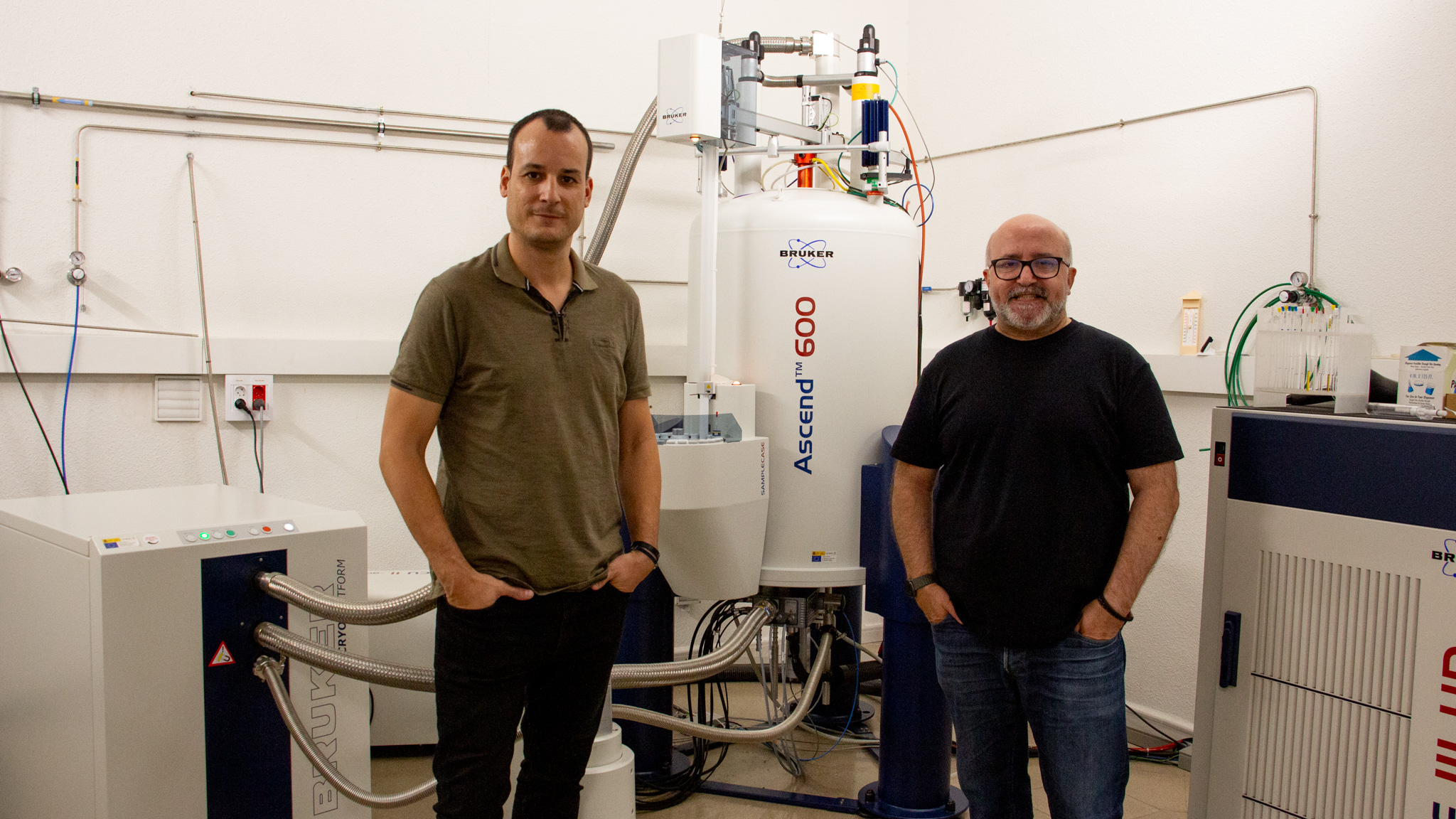
An international team with the participation of the Institute of Chemical Research (a joint center of the CSIC and the University of Seville) has developed a technique that could transform the early stages of drug development. This advance combines nuclear magnetic resonance spectroscopy with artificial intelligence tools to identify and classify compounds with the greatest therapeutic potential much more rapidly and accurately. The research has been published in the prestigious Journal of the American Chemical Society.
The new methodology, called SHARPER nuclear magnetic resonance spectroscopy, optimized through machine learning—a technique that combines advanced nuclear magnetic resonance with artificial intelligence to accelerate compound analysis—makes it possible to rapidly analyze how small molecules, known as fragments, bind to proteins that may serve as therapeutic targets.
Thanks to this technique, researchers can evaluate around 140 fragments per day, compared with 4 to 15 using conventional methods—an unprecedented speed in nuclear magnetic resonance spectroscopy. In addition, it offers a high degree of automation in both data acquisition and result analysis, making it a high-throughput tool. This increase in speed multiplies analytical capacity tenfold and opens the door to a much more agile and efficient search for new drugs.
A pioneering methodology
“We have developed a pioneering methodology that significantly accelerates the earliest stages of drug development, greatly facilitating the work of researchers involved in the design and optimization of new medicines,” highlights first co-author Ridvan Nepravishta, from Cancer Research Horizons.
The technique markedly improves the use of nuclear magnetic resonance to study how small molecules bind to proteins, a key step in drug design. Traditionally, this process is very time-consuming and requires large amounts of protein to detect weak interactions between fragments and proteins. Although difficult to observe, these weak interactions—subtle molecular contacts—are essential for identifying compounds that could become future drugs.
The new approach concentrates the molecular signal into a clearer and more precise readout, making it possible to observe how it changes upon interaction with the candidate protein and significantly improving experimental sensitivity. In addition, the use of machine learning algorithms has drastically reduced the number of measurements required. With just two different fragment concentrations, researchers can accurately classify an entire collection of compounds. This represents a radical simplification of the experimental process, which previously required up to seven measurements per compound.
“Our ML-Boosted LB SHARPER NMR approach is very easy to implement and automate, both experimentally and in data analysis,” comments Jesús Angulo, co-author of the article. This automation enables accurate classification of the fragments that interact most effectively with a protein of interest—the so-called “hits”—within libraries that may contain hundreds or thousands of candidates, an advance that is particularly valuable for the pharmaceutical industry.
Fragment-based drug design
This development is framed within one of the most widely used strategies in drug design: Fragment-Based Drug Discovery (FBDD). This approach involves identifying small molecular building blocks that bind to proteins involved in disease and then optimizing them to improve their efficacy. However, these interactions are often very weak and difficult to detect using traditional techniques such as X-ray crystallography or electron microscopy. Nuclear magnetic resonance is one of the few tools capable of studying these interactions, but its low sensitivity and time requirements have so far limited its application in drug discovery campaigns.
With this new technique, researchers have overcome these limitations. First co-author Juan C. Muñoz-García, a researcher in the EMERGIA Talent Attraction Program of the Andalusian Regional Government at the Institute of Chemical Research, emphasizes: “This work is a perfect example of the impact of multidisciplinary research and international collaboration, in which we have demonstrated that combining advanced nuclear magnetic resonance spectroscopy with machine learning techniques makes it possible to accelerate the classification of the most promising compounds (‘hits’) against a biological receptor to levels that were previously inconceivable in the field of nuclear magnetic resonance.”
This advance not only improves the speed and accuracy of analysis, but also reduces protein consumption and simplifies the experimental process, making it more accessible to both academic laboratories and biotechnology companies. Overall, this methodology represents an important step toward faster and more efficient development of new pharmacological treatments.
Reference
R. Nepravishta, J. C. Muñoz-García, K. Cameron, J. Angulo, D. Uhrín (2025). Fast and reliable NMR-based fragment scoring for drug discovery. Journal of the American Chemical Society.
DOI: https://doi.org/10.1021/jacs.5c11092