


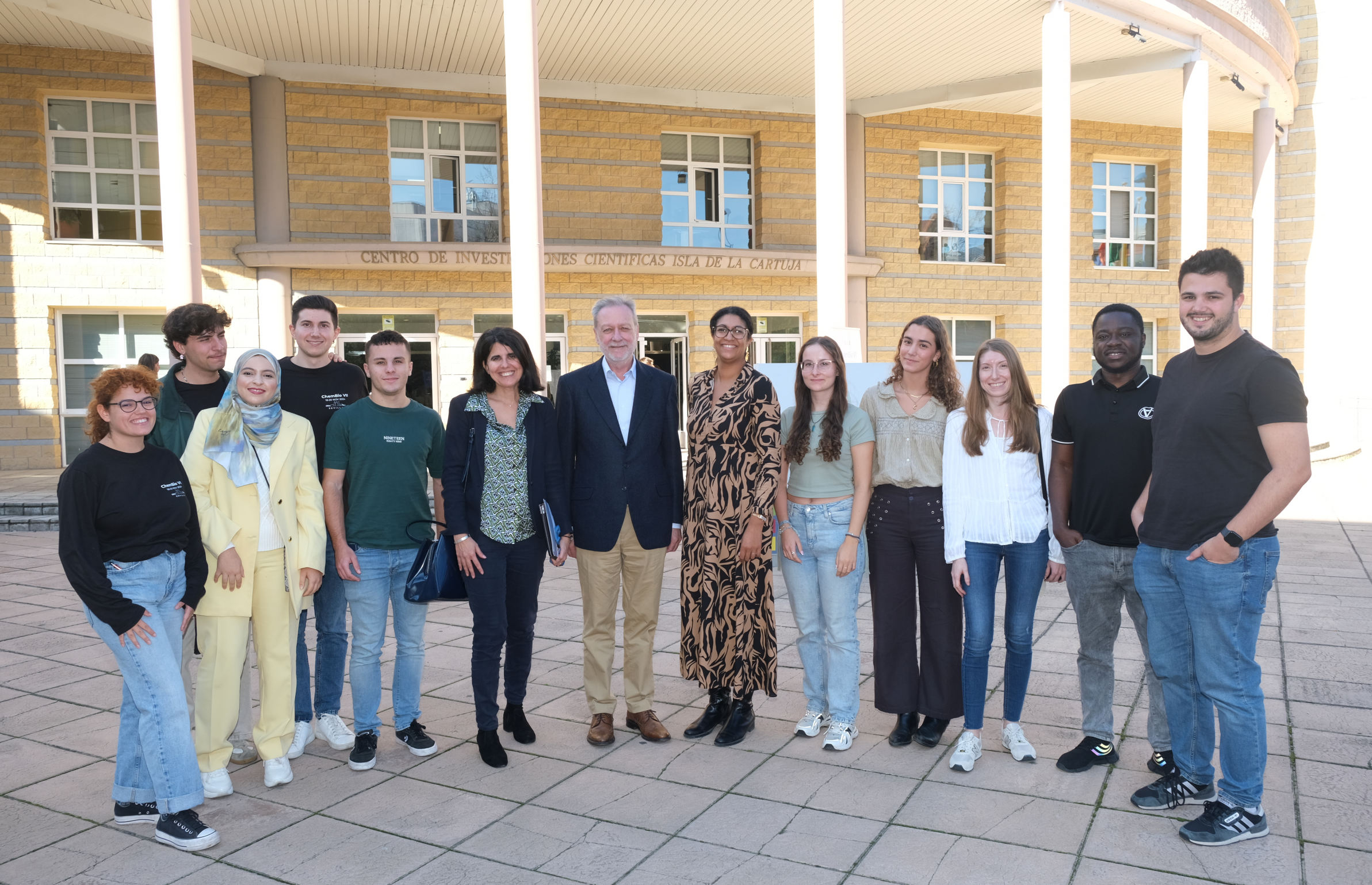
Members of the Biointeractomics research group | Diario de Sevilla (M.G.)
A multidisciplinary and international study has revealed the decisive contribution of cathepsin B to the progression of alcoholic hepatitis, a serious disease affecting millions of people worldwide and one of the main causes of alcohol-related liver damage. The work, carried out by the University of California, San Diego in collaboration with a Biointeractomics research group from the Institute of Chemical Research (a joint center of the CSIC and the University of Seville) and fifteen other institutions from the United States, Germany, the Netherlands, and Japan, has identified this enzyme as the key protein in the development of the disease.
The findings have been published in the Journal of Hepatology, a leading journal in liver research, and represent a major step forward in understanding the role of cathepsin B, which until now was poorly understood. “Identifying the molecular details of the causal agents in the progression of alcoholic hepatitis brings us closer to designing effective treatments, which have not yet been developed,” explains Professor Irene Díaz-Moreno of the University of Seville, from the Institute of Chemical Research at the Scientific Research Center Isla de la Cartuja (IIQ-cicCartuja, US-CSIC).
The study analyzed proteins present in fecal samples from 119 patients from five centers in the Americas and Europe: 80 with alcoholic hepatitis, 20 with alcohol use disorder, and 19 healthy controls. The results showed that cathepsin B levels progressively increase in patients with alcohol use disorder and alcoholic hepatitis compared to controls, and that these elevated levels are associated with higher mortality.
Additionally, experiments in mouse models exposed to alcohol demonstrated that liver macrophages are responsible for expressing and secreting cathepsin B. Once released, the enzyme reaches the intestine, where it degrades proteins that maintain the integrity of the intestinal epithelium. The weakening of this barrier facilitates the passage of bacterial toxins to the liver, promoting the progression of liver damage. Genetic deletion of cathepsin B in macrophages or its inactivation using a specific inhibitor prevented this degradation and reduced the associated damage.
The Biointeractomics group contributed to elucidating, through computational methods and molecular modeling, the structural mechanisms by which cathepsin B recognizes and degrades proteins of the intestinal epithelium, as well as characterizing how its specific inhibitor blocks this interaction at the atomic level. These results will enable the development of new therapeutic strategies to block the action of cathepsin B.
Overall, the research provides a comprehensive view of the mechanism linking chronic alcohol consumption with disruption of the intestinal barrier and the progression of liver disease, and identifies cathepsin B as a key causal factor in alcoholic hepatitis, a condition that currently has limited therapeutic options.
Interview with Irene Díaz and Joaquín Tamargo in Diario de Sevilla