


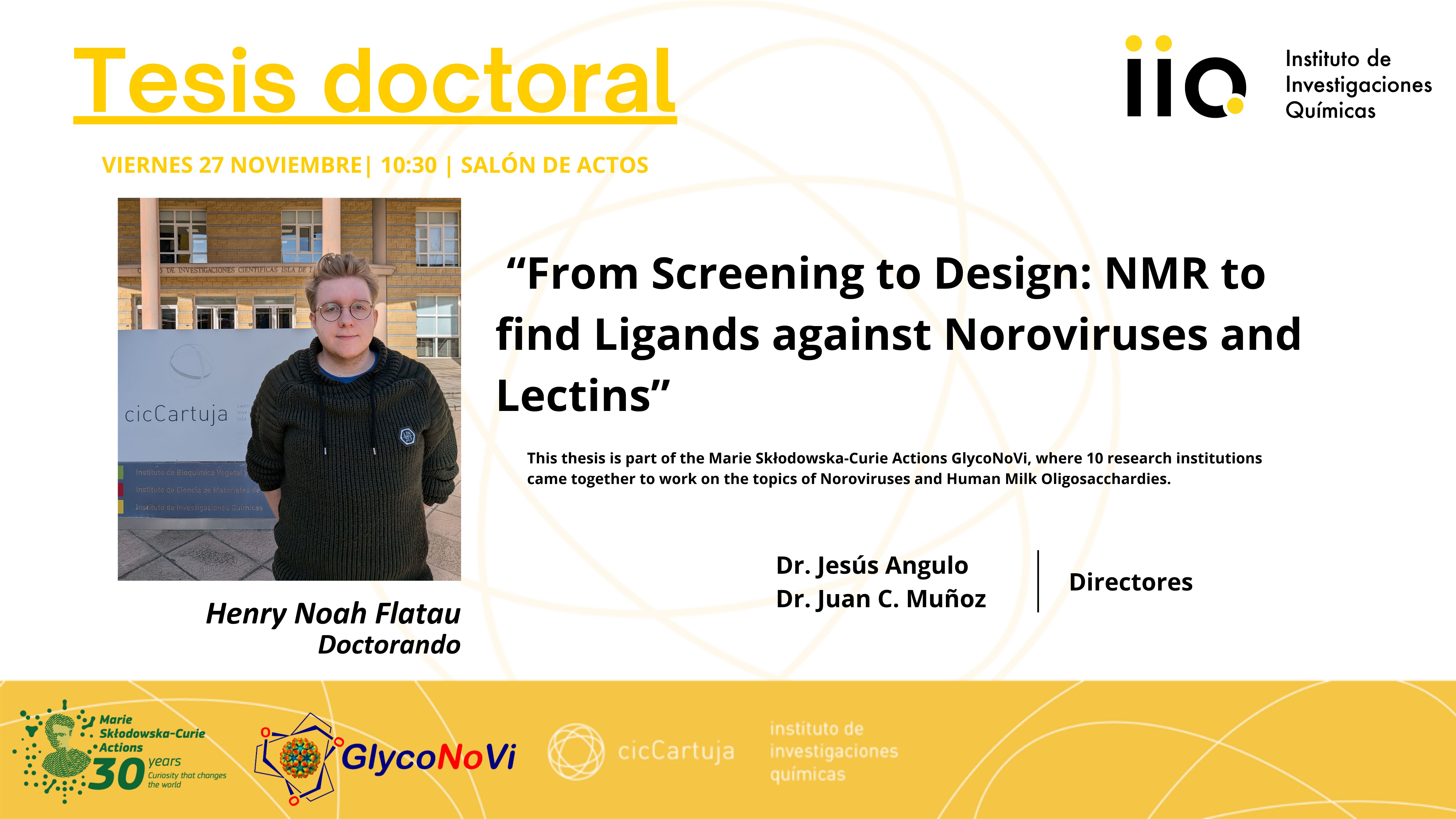
Next Friday, 27 November at 10.30 am, Henry Noah Flatau will defend his doctoral thesis, “From Screening to Design: NMR to find Ligands against Noroviruses and Lectins”, in the CicCartuja Assembly Hall.. This thesis is part of the Marie Skłodowska-Curie Actions GlycoNoVi, where 10 research institutions came together to work on the topics of Noroviruses and Human Milk Oligosacchardies. His thesis was supervised by Dr Jesús Angulo and Dr Juan Carlos Muñoz.
“From Screening to Design: NMR to find Ligands against Noroviruses and Lectins”
Norovirus is a highly contagious virus and the leading cause of gastroenteritis. It is particularly dangerous for babies and older adults. Although noroviruses represent a major global health burden, there are currently no approved medicines or vaccines against them.
Norovirus enters cells by binding, through a protein called the P-domain, to sugar molecules on the surface of human cells. These sugars, known as human blood group antigens, are therefore required for infection.
Human breast milk contains sugars that are very similar to human blood group antigens. These are called human milk oligosaccharides (HMOs). HMOs are associated with many beneficial effects. One of these is a decoy-receptor effect: due to their similarity to blood group antigens, HMOs can interfere with the attachment of noroviruses to cells and may therefore help protect against infection.
This thesis investigates which and how HMOs interact with norovirus and other sugar-binding proteins (lectins). Using nuclear magnetic resonance (NMR) spectroscopy together with computer-based modelling, a library of natural HMOs and related synthetic compounds was tested against several norovirus types. The results show that different norovirus types recognise HMOs differently and that a particular sugar component, fucose, plays a central role in these interactions.
Additionally, the thesis examines whether HMOs also interact with proteins from fungi and with human immune cells. The results show, that HMOs bound strongly to a lectin from the disease-causing fungus Aspergillus fumigatus, providing the first direct evidence that these breast-milk sugars can interact with a fungal pathogen.
In the case of DC-SIGN, an important human immune receptor involved in recognising pathogens and regulating immune responses, the thesis shows that a broad range of HMOs interact with DC-SIGN. This interaction may be important for the regulation of the immune system in infants.
Overall, this work shows that HMOs are versatile molecules that may help protect infants from infection and shape immune development. It also identifies promising starting points for the development of new norovirus and fungal inhibitors.