


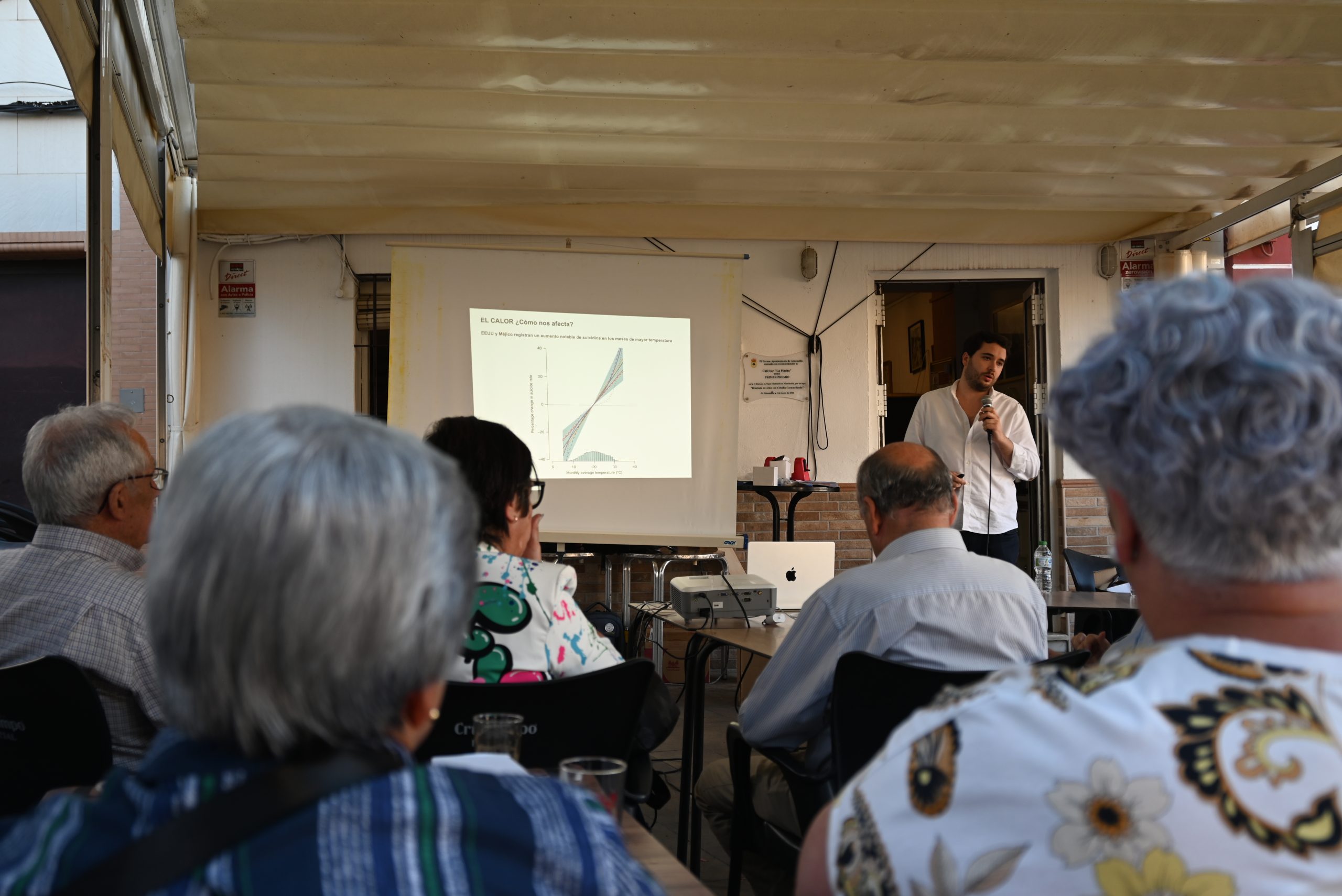
Javier de Sola during the Pint of Science in Bar La Placita (Almensilla)
Why do you eat? Who owns the message? How much green do you breathe? What happens when atomic nuclei collide? These and many other equally intriguing questions form part of the titles of the science talks to be held on 18, 19 and 20 May in the province of Seville, as part of the Pint of Science festival, the world’s largest free science outreach event.
At this festival, researchers from all disciplines bring their work to the public in an unusual setting for science: pubs, transforming these everyday spaces into meeting points for knowledge and curiosity.
Pint of Science in Almensilla
As part of the festival’s commitment to bringing science to less populated areas, Pint of Science will host Almensilla, in Seville’s Aljarafe region, as its venue for the fourth consecutive year.
On Monday 18, Tuesday 19 and Wednesday 20 May, various bars in Almensilla will host a total of six science talks aimed at answering questions such as: ‘Can artificial intelligence save lives?’ or ‘What would happen if we could bring the energy of the stars to Earth?’, where attendees can hear the answers to these and many other intriguing questions in a friendly and interactive setting. The sessions will take place on Monday at Bar La Placita (Plaza de la Iglesia, 5), on Tuesday at Bar La Atarazana 1920 (Calle Jesús, 19) and on Wednesday at Restaurante Los Carros (Calle Cercadillo, 2A) at 7.00 pm.
The programme will feature talks of great social interest; for example, Casilda Rueda Fernández will explain the importance of upholding international law, whilst Luis Merino Cabañas will discuss how robots are adapting to society. Other talks will focus on technology in the service of medicine: Raúl Fernández Mateo will explain how physics is integrated into the detection of antibiotic-resistant bacteria, and Juan Antonio Ortega Ramírez will analyse the impact of artificial intelligence on medicine. Finally, the festival programme will cover the environment and new energy sources, with David Gallego Puyol demonstrating how navigation logs can be used to reconstruct past climates, and Carlos López Jiménez, Jesús Salas Suárez-Bárcena, Lina Velarde Gallardo and Pilar Cano Megías explaining how Seville is contributing to the development of nuclear fusion energy. The full programme for Almensilla is available at: https://pintofscience.es/events/almensilla/.
“Bringing research to all audiences, openly and free of charge, as Pint of Science does, makes it easier for smaller towns to access the cutting-edge knowledge being generated around them,” says Andrea Fernández Veloso, the festival’s coordinator in Almensilla and a native of the town.
Pint of Science in Seville city centre
In Seville, Pint of Science will take place at La Tregua Café-Bar, Sala El Cachorro and Taberna del Dragón Verde at 7.00 pm, with a total of 18 science talks covering a wide range of topics: The Wonderful Mind, Our Body and Planet Earth, right through to Our Society and Atoms and Galaxies. Among the researchers and scientists taking part in this edition of Pint of Science Seville are Marta Martínez Bernardo, who will help us understand how the lunar cycle affects patterns of activity in nature; Manuela Rodríguez Gallardo, explaining what happens when two atomic nuclei collide; and Isabel Cerrillo García, who will teach us how to feed ourselves without destroying the planet. The full programme can be viewed on the website https://pintofscience.es/events/sevilla
One of the organisation’s objectives in Seville is to establish direct dialogue between researchers and society. Sandra Medrano, a postdoctoral researcher and head of National Communications for this edition, explains that “we tend to think that science is complicated, but that’s perhaps because it hasn’t been explained to us properly. Pint of Science is special because we use understandable language and the bars create a unique, informal atmosphere that encourages attendees to ask questions and helps us all learn complex science in a simple way.”
Pint of Science across the rest of Spain, strengthening science in rural areas
In total, the free Pint of Science Spain science festival in pubs will bring a total of 1,300 researchers to 114 towns and villages on 18, 19 and 20 May. This year, as a new initiative, it will strengthen its presence in less populated areas across the rest of Spain, bringing science to pubs in 29 rural areas participating for the first time through informative talks, monologues and experiments presented in simple language and in a friendly, participatory atmosphere. After each session, the public will be able to interact directly with the scientists, fostering an open and accessible dialogue that answers all their questions and satisfies their thirst for science.
One of the organisation’s main objectives is to bridge the gap between scientific knowledge and areas far from major urban centres. Small towns are often left out of the usual circuits of science outreach events, which limits access to up-to-date scientific information. “It is essential that science reaches every corner, not just the big cities. In villages, too, there is curiosity, talent and a desire to learn,” explains Sandra Medrano Garcia, Head of Communications, who emphasises that the intimate setting created in bars facilitates more open and participatory conversations.
One of the key features of this year’s festival is the role of researchers who, faced with a lack of job opportunities in their home towns, have pursued their careers elsewhere in the country or abroad. Many of these people return temporarily to their villages to take part in the festival, sharing their knowledge with family, friends and neighbours. This symbolic return not only brings science closer to the community but also strengthens the bond between the community and those who have had to leave to pursue their professional careers.
Bringing the Pint of Science festival to the pubs of Almensilla, as well as to other rural towns, highlights the importance of raising the profile of scientific role models in rural contexts, where access to such figures is more limited. Direct interaction helps dispel the notion that science is inaccessible or distant, showing that behind every piece of research there are people with relatable stories and shared experiences.
The festival’s national coordinator, Carlos Peris Torres, emphasises that “every talk in a rural setting is a unique opportunity to spark interest and inspire vocations. When someone sees that a neighbour from their own community has managed to build a scientific career, it helps make this path seem more accessible and achievable. Science belongs to villages too, and this festival is a way of giving that knowledge back to them”.
Eleven years of Pint of Science in Spain
Over the course of its ten previous editions in Spain, Pint of Science has transformed science communication into a genuine social experience, with 2,200 events held in 1,000 pubs, the participation of over 5,300 researchers, and attendance by around 130,000 people. Against this backdrop, the eleventh edition promises to be the most ambitious to date, both in terms of the number of activities planned and the increase in the number of locations involved.
The initiative began in May 2013 in the UK, when researchers Michael Mostkin and Praveen Paul organised a talk in their own laboratories to bring their work closer to people affected by various mental health conditions. The impact was so positive that a key question arose: “if people go to laboratories… why not take science to where the people are, the pubs?”.
What began as a local idea has grown into a global phenomenon. In 2026, Pint of Science will be held simultaneously across five continents, with 27 countries taking part. Australia will be the starting point for this international science outreach marathon, opening its pubs to knowledge and kicking off three consecutive days of shared science around the world.
In Spain, the initiative is driven by the Pint of Science Spain Science Communication Association, which relies on the coordinated efforts of over 750 volunteers, as well as the support of numerous sponsors and partners who make each edition possible.
On 18, 19 and 20 May, science will take over the bars to be discussed, understood and enjoyed in a unique atmosphere. We look forward to seeing you there.
Pint of Science 2026 is a free event for anyone who wishes to attend, and it would not be possible without the collaboration of organisations sponsoring the festival locally in Almensilla, such as the Specialised Group on Inorganic Chemistry of the Royal Spanish Society of Chemistry (GEQI-RSEQ), and nationally, such as the Pfizer Foundation, Labbox, CESIF, VHIO, Miltenyi, JJNN, Vadillo Asesores and more than 70 local sponsors. Furthermore, Seville has local partners, such as the University of Seville, Pablo de Olavide University and Loyola University.