


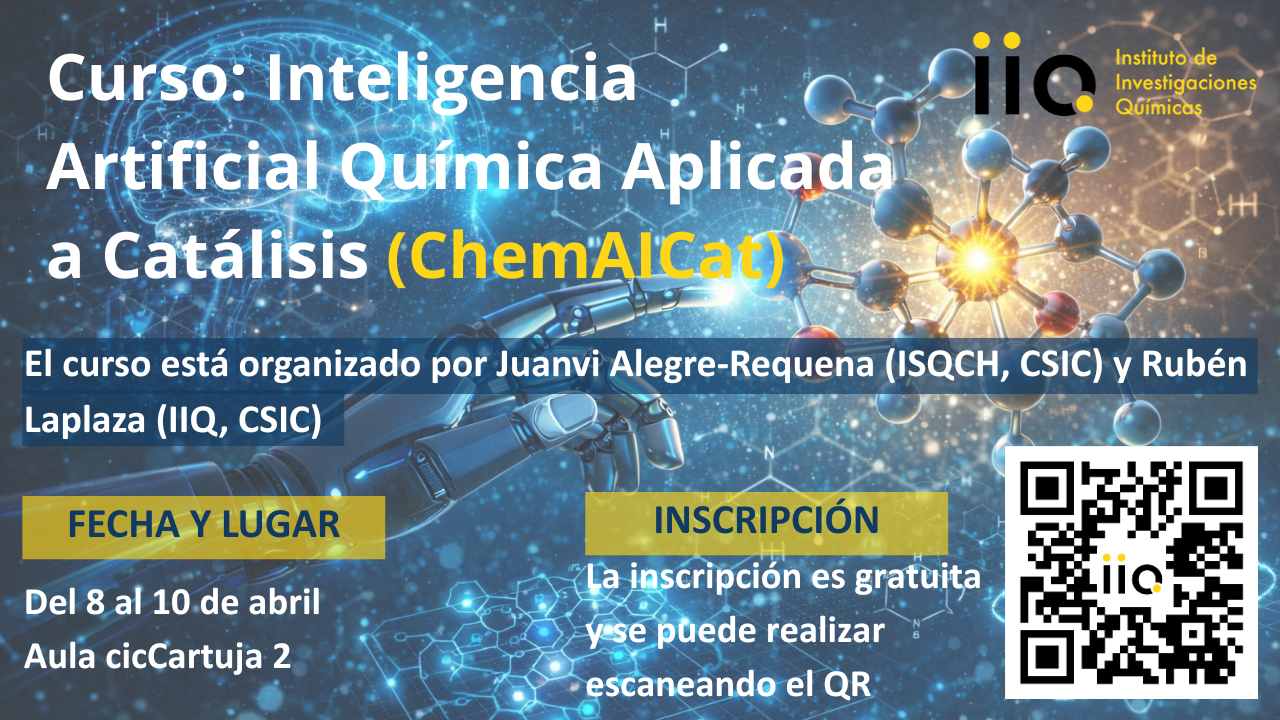
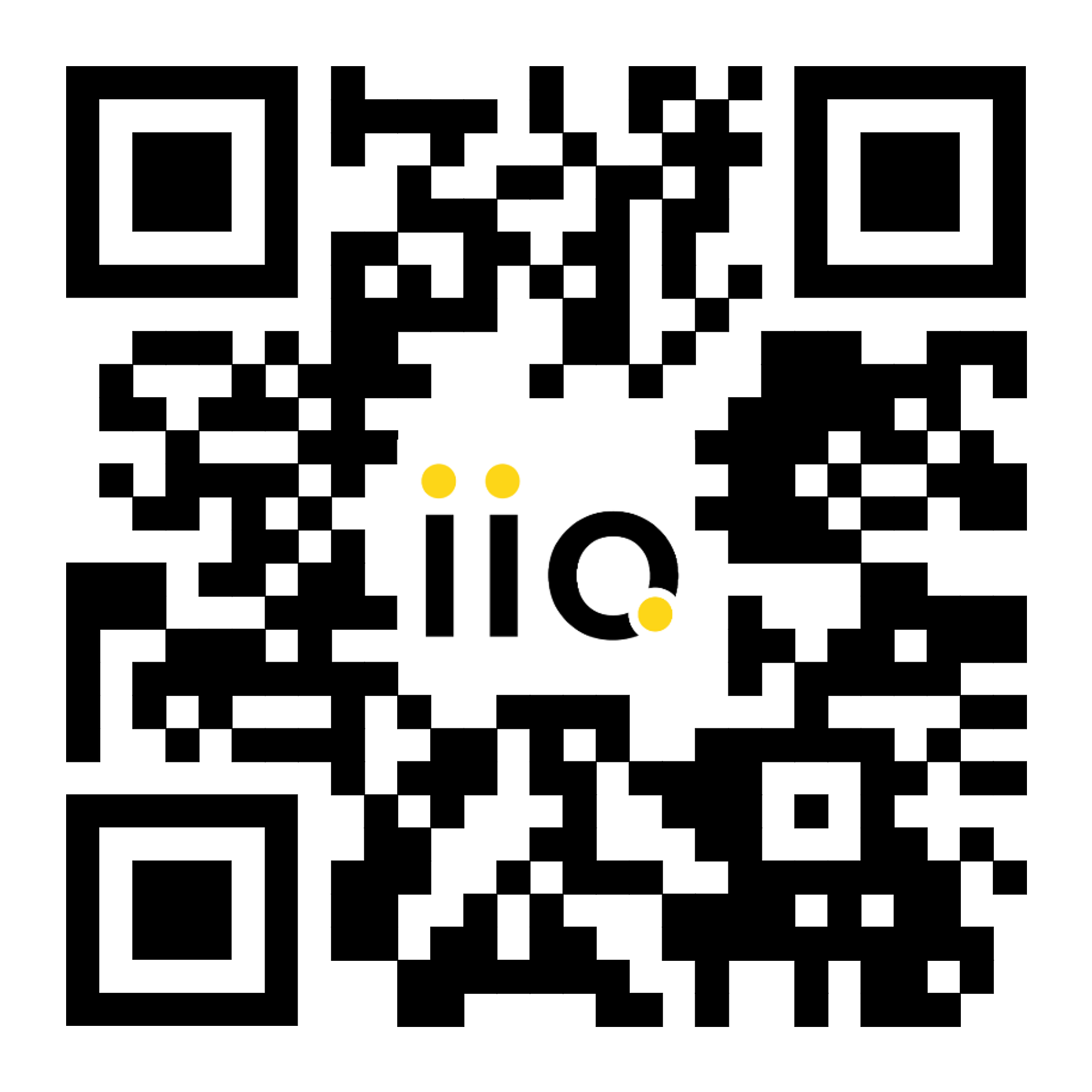
Dr. Rubén Laplaza Solanas (Institute of Chemical Research, IIQ – CSIC–University of Seville), together with Itzel A. Muro-Puente, Dr. David Dalmau, and Dr. Juan V. Alegre-Requena (Institute of Chemical Synthesis and Homogeneous Catalysis, ISQCH – CSIC–University of Zaragoza), will deliver the course “Artificial Intelligence in Chemistry Applied to Catalysis (ChemAICat)” from April 8 to April 10, 2026. The course will take place in the cicCartuja II Classroom. Registration is free, and the number of participants is limited to 30. Interested participants must complete the registration form or scan the QR code below to sign up.
The course provides a practical guide to different AI techniques that can be applied to accelerate or complement research in catalysis. It is particularly recommended for experimental and computational chemists with little or no experience in Python programming. The classes aim to provide these researchers with ready-to-use workflows that they can incorporate into their own research tasks.
Some of the protocols that will be covered include:
-
Molecule and catalyst generation through digital reactions
-
Automated generation of descriptors from ChemDraw and CSV files
-
Efficient, data-driven chemical exploration
-
Reaction condition optimization using AI
-
Catalyst discovery with AI
Most sessions will consist of hands-on tutorials, where participants will follow along and execute code demonstrated by the instructor. In some cases, 30-minute seminars will be included to complement the practical sessions.
Requirements
Before attending the course, the following requirements must be met:
-
Participants must use their own laptops to run the programs used during the course. Windows, macOS, and Linux operating systems are supported.
-
Complete a preliminary installation guide to set up the necessary Python environments. Instructions will be provided a few weeks before the course, and the setup should take 30–60 minutes.
-
(Optional) Share any custom problems in advance that could be included in the problem-solving sessions. This will allow the workshop to focus on topics relevant to the audience.
Program
Wednesday, April 8
Introduction to Python
Supervisor: Itzel A. Muro-Puente
Time: 9:30 AM – 11:00 AM
Short Break: 11:00 AM – 11:30 AM
Data Visualization with Python
Supervisor: Itzel A. Muro-Puente
Time: 11:30 AM – 1:00 PM
Lunch Break: 1:00 PM – 3:00 PM
Introduction to Chemoinformatics
Supervisor: Rubén Laplaza
Time: 3:00 PM – 4:30 PM
Recommended readings: Introduction to RDKit and Integrating Digital Chemistry within the Broader Chemistry Community
Q&A and Custom Problem-Solving Session
Time: 4:30 PM – 5:30 PM
Thursday, April 9
Digital Reactions for Catalyst Generation
Supervisor: Rubén Laplaza
Time: 9:30 AM – 11:00 AM
Recommended readings: SMARTS Tutorial and SMILES Tutorial (Reactions section)
Short Break: 11:00 AM – 11:30 AM
Introduction to Chemical AI and Descriptor Generation
Supervisor: Juan V. Alegre-Requena
Time: 11:30 AM – 1:00 PM
Recommended readings: Machine Learning in Homogeneous Catalysis: Basic Concepts and Best Practices, Navigating through the Maze of Homogeneous Catalyst Design with Machine Learning and Paving the Road towards Automated Homogeneous Catalyst Design
Lunch Break: 1:00 PM – 3:00 PM
Chemical Space Exploration and Catalyst Sampling
Supervisor: Juan V. Alegre-Requena
Time: 3:00 PM – 4:30 PM
Recommended readings: Standardizing Substrate Selection: A Strategy toward Unbiased Evaluation of Reaction Generality and Accelerated Dinuclear Palladium Catalyst Identification through Unsupervised Machine Learning
Friday, April 10
AI-Guided Reaction Condition Optimization
Supervisor: David Dalmau
Time: 9:30 AM – 11:00 AM
Recommended readings: Bayesian Reaction Optimization as a Tool for Chemical Synthesis and Race to the Bottom: Bayesian Optimisation for Chemical Problems
Short Break: 11:00 AM – 11:30 AM
AI-Guided Catalyst Discovery
Supervisor: David Dalmau
Time: 11:30 AM – 1:00 PM
Recommended readings: ROBERT: Bridging the Gap Between Machine Learning and Chemistry and Recent Advances of Machine Learning Applications in the Development of Experimental Homogeneous Catalysis
Q&A and Custom Problem-Solving Session
Time: 1:00 PM – 2:00 PM
Course Farewell: 2:00 PM