


Experts are therefore proposing the design of biomimetic antimicrobial agents—that is, agents inspired by natural systems that combine nanomaterials with organic biomolecules. These are molecules found in living organisms, such as those that make up DNA or proteins. In the future, this approach could be used to develop new systems with antifungal, anticancer or antimicrobial activity.
The novelty of the work lies in the combination of two components that, separately, have no antibacterial activity. On the one hand, very small nanoparticles of ruthenium, a metal used in chemistry and catalysis—that is, to accelerate chemical reactions. On the other, an organic molecule derived from uracil, one of the components that make up the genetic material of living organisms. When both are integrated into a single nanometric structure, they act together and acquire the ability to eliminate bacteria.
As the research team explains in the article ‘Ru Nanoparticles Ligated by an N-Heterocyclic Carbene Derived from Uracil Nucleoside as Selective Antimicrobial Agents’, published in the journal Inorganic Chemistry, this combination produces a synergistic effect, meaning that the metal and the organic molecule act cooperatively. “Our aim was to design an antimicrobial agent that would be active against problematic bacteria, but at the same time selective and low in toxicity,” explains IIQ-CSIC researcher Luis Miguel Martínez Prieto to the Descubre Foundation.
In a single step
To produce these nanoparticles, the researchers devised a simple method that allows them to be obtained in a single step. To do this, they combined a ruthenium precursor—a compound containing this material that serves as a starting point for forming the nanoparticles—with an organic molecule derived from uracil, a substance found in DNA. The latter acts as a kind of ‘mould’, stabilising and controlling the size of the nanoparticle. Much like in a recipe, this ‘guiding’ ingredient causes the metal to cluster into very small particles and prevents large clumps of metal from forming, keeping them separate.

Furthermore, this system allows them to be produced more efficiently, at low temperatures and without generating unnecessary waste. In addition, the process takes place within a single reactor, which simplifies the formation of the nanoparticles.
Once obtained, the scientists verified their size and shape using high-resolution microscopy techniques, confirming that they were very small and well-organised particles. “We used a very powerful electron microscope to observe how the atoms are arranged inside them and their crystalline structure. This internal order, similar to that of a honeycomb, ensures that the particles stay together and are effective,” explains Luis Miguel Martínez Prieto.
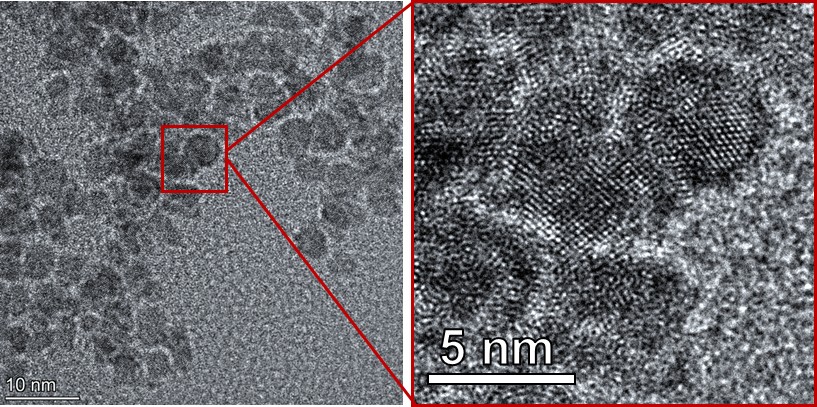
In addition, the team carried out theoretical calculations using advanced computational tools to confirm how the organic molecule binds to the surface of the nanoparticles, a step that helps to provide a deeper understanding of how it works.
Selective activity
To assess their antimicrobial activity, the researchers compared various reference materials: the uracil derivative on its own, a similar ruthenium complex, nanoparticles without the biomolecule, and others of the same type but larger in size. The experiments showed that only the smallest nanoparticles coated with the uracil derivative exhibited antibacterial activity.
Furthermore, they observed that the effect was selective, as the nanoparticles were active against the bacterium Staphylococcus aureus but showed no activity against other bacteria. This highlights their therapeutic potential, given that one of the challenges when using an antimicrobial agent is to prevent it from indiscriminately affecting various microorganisms in the human body or from promoting the development of resistance. “For this reason, designing compounds capable of acting selectively is one of the strategies being explored to develop new treatments,” adds Luis Miguel Martínez Prieto.
New strategies against drug-resistant bacteria
The next steps for the CATANA group (IIQ-CSIC-University of Seville) will involve testing other biomimetic combinations, organic biomolecules and metallic nanoparticles, with a view to developing new materials for biomedical applications, such as combating hard-to-treat infections.
This work has been funded by the Regional Ministry of Universities, Research and Innovation of the Regional Government of Andalusia through the project of excellence ‘Hydrogenation of CO2 into renewable fuels by magnetic heating: an efficient way to store intermittent energies’ and the Institute of Chemical Research’s (IIQ-CSIC-University of Seville) own funds.
Feature article: Nanopartículas para combatir bacterias: cuando la unión hace la fuerza
Reference
Sánchez, A., Carrascosa, L. A., Romeo, G., Orsini, G., Coppel, Y., Santamarina, S., … & Martínez-Prieto, L. M. (2026). Ru Nanoparticles Ligated by an N-Heterocyclic Carbene Derived from Uracil Nucleoside as Selective Antimicrobial Agents. Inorganic Chemistry.