


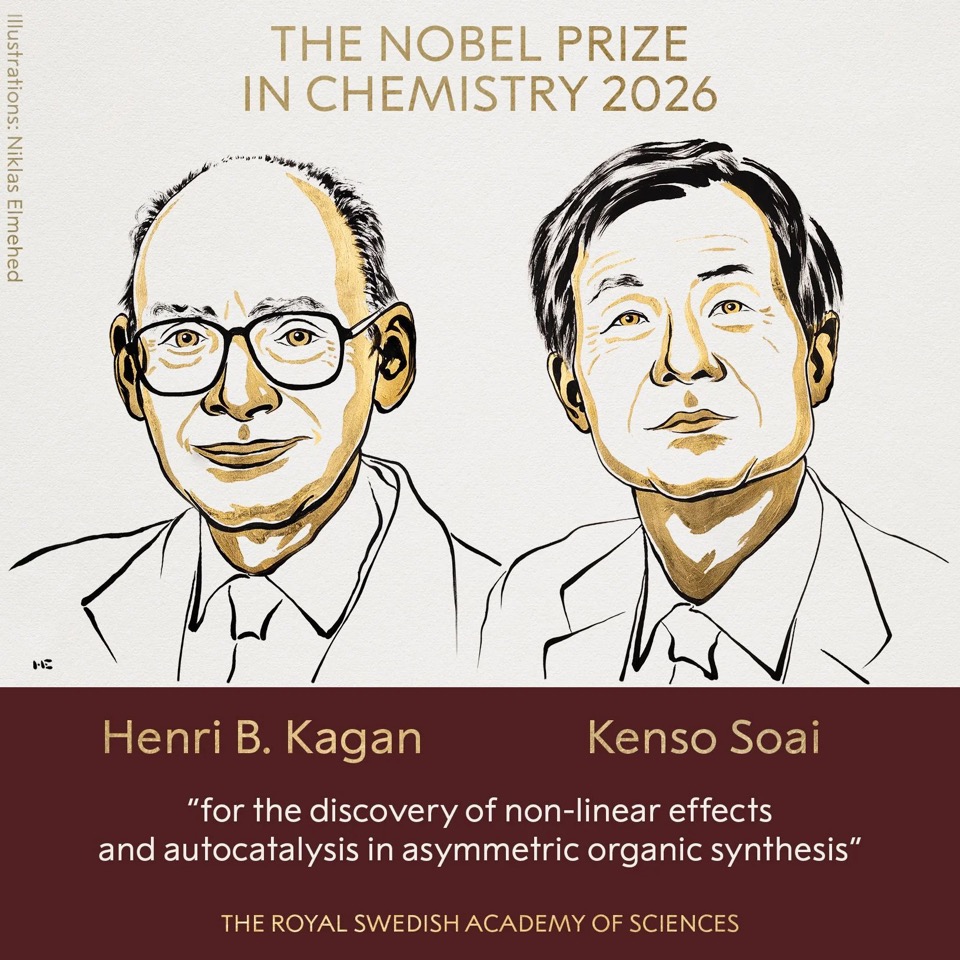
2026 Nobel Prize in Chemistry. (Nobel Prize)
By Noureddine Khiar, principal investigator of the Asymmetric Synthesis and Functional Nanosystems group
The Royal Swedish Academy of Sciences has awarded the 2026 Nobel Prize in Chemistry to Henri B. Kagan and Kenso Soai for their work on non-linear effects and autocatalysis in asymmetric organic synthesis, discoveries which helped to explain how a small molecular asymmetry can be amplified to the point of generating systems dominated by just one of the two possible mirror images of a molecule—that is, by a single enantiomer.
For many chemists, the announcement also had an immediate implication: at last, Kagan. His name had been omitted from the 2001 Nobel Prize in Chemistry, which was awarded to William Knowles, Ryoji Noyori and Barry Sharpless for the development of asymmetric catalysis. Since then, numerous researchers have considered that Kagan, a key pioneer in the field, deserved to have been among the laureates of that year’s prize. Kagan was one of the great architects of modern asymmetric synthesis. In 1971, he developed DIOP, a chiral bidentate diphosphine with C₂ symmetry, which helped to establish a fundamental principle: the symmetry and three-dimensional geometry of a ligand could be designed to control which enantiomer a reaction produces. This concept was to have an enormous influence on the subsequent development of chiral ligands and modern asymmetric catalysis. His scientific career was, however, much broader in scope. His numerous contributions also include the asymmetric synthesis of chiral sulphoxides and the introduction of samarium(II) iodide, SmI₂, known as the Kagan reagent, which would become a fundamental tool for reductions, radical cyclisations and the formation of carbon–carbon bonds.
But his decisive contribution to the 2026 Nobel Prize came in 1986, when he demonstrated the so-called non-linear effects: a small difference in the enantiomeric composition of a catalyst can result in a much greater difference in the product. Chemistry, therefore, can amplify asymmetry. Until then, it had been assumed almost intuitively that the enantiomeric purity of the product must vary in proportion to that of the catalyst. Kagan’s experiments showed that the relationship could be far more complex and, under certain conditions, lead to a very marked amplification of chirality. Kenso Soai took this principle even further. In 1995, he described an asymmetric autocatalytic reaction in which the chiral product itself catalyses its own formation. A slight initial advantage of one of the enantiomers progressively generates more molecules of that same configuration, amplifying the imbalance. The significance of these discoveries extends far beyond organic synthesis. Life exhibits an extraordinary characteristic: its main biological molecules show a strong preference for one of their two chiral forms. The amino acids that make up proteins belong almost exclusively to the L series, whilst the sugars present in DNA and RNA belong to the D series. This property, known as homochirality, is essential for the functioning of biological systems. Kagan and Soai’s work does not definitively explain how this preference arose on the early Earth, but it did demonstrate something fundamental: an initially minuscule asymmetry can be amplified, through purely chemical processes, to the point of generating a system dominated almost entirely by a single chiral form. That is why the 2026 Nobel Prize links chemists’ ability to control the three-dimensional structure of molecules to one of the great questions about the origin of life: how could such a marked preference for one of the two possible forms of chiral molecules have arisen?
And, after decades of influence on catalysis, stereochemistry and modern organic synthesis, the announcement also carries a particularly simple significance: At last, Kagan.