


By Noureddine Khiar:
The announcement of the 2025 Nobel Prize in Chemistry immediately brings to mind a famous statement by Marcellin Berthelot, one of the founders of modern Chemistry:
“La chimie crée son objet. Cette faculté créatrice, semblable à celle de l’art lui-même, la distingue essentiellement des sciences naturelles et historiques.”
With this assertion, Berthelot underscored the uniquely creative nature of Chemistry: a discipline that does not merely describe reality, but has the capacity to generate new material entities, expanding the boundaries of what is possible. This view contrasts with the criticism formulated decades later by John Maddox, editor of Nature, who argued that Chemistry had lost its identity as an autonomous Science, citing as an example the 1985 Nobel Prize in Chemistry, awarded to Herbert A. Hauptman and Jerome Karle for their mathematical contributions to crystallography [Maddox, Nature, 1985].
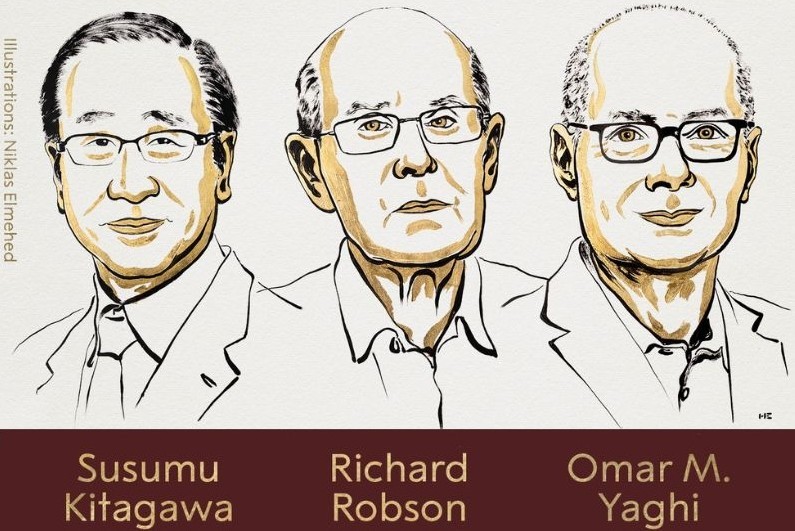
This year’s 2025 Nobel Prize seems to offer a compelling response to that criticism. It has been awarded to Omar M. Yaghi, Susumu Kitagawa, and Richard Robson for the development of metal–organic frameworks (MOFs), crystalline materials formed by linking metal ions with organic ligands. These three-dimensional structures, comparable to molecular networks, feature highly defined and tunable internal pores, with internal surface areas reaching up to 7,000 m² per gram. This extraordinary porosity makes MOFs true molecular sponges, capable of storing gases, catalyzing chemical reactions, purifying water, or releasing drugs in a controlled manner.
To read the full text, click here.